Book Review: The Documents of Vatican II
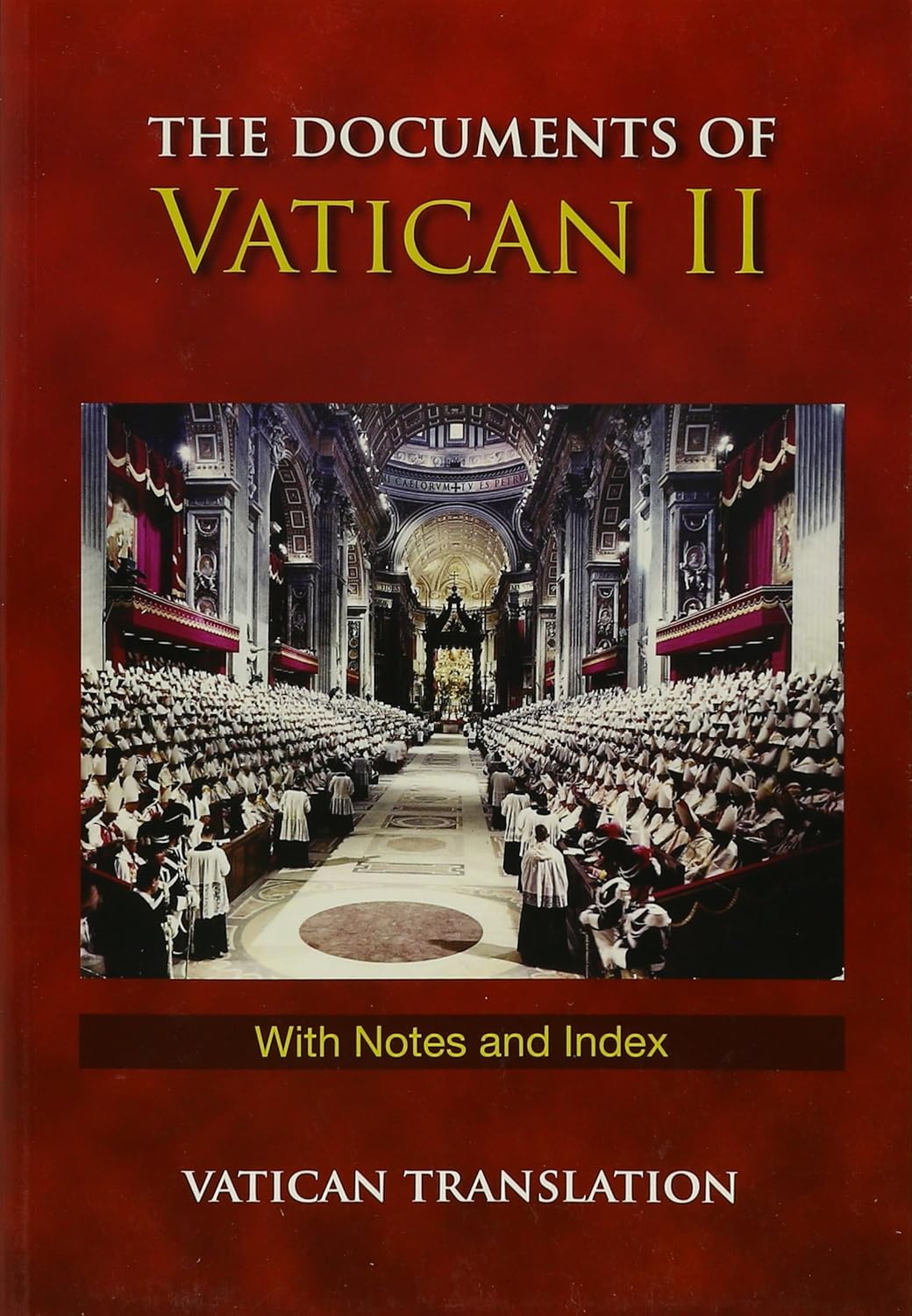
Growing up, I often heard about the many changes in the Catholic Church that followed Vatican II. It was a spiritually challenging time for many Catholics and for the broader culture. Many parishes experienced dramatic shifts in liturgy and practice, resulting in diminished reverence and understanding of the sacraments, particularly the Eucharist. I wasn’t there to witness it firsthand, but we still experience its effects in the Church and the wider culture.
The Catholic Church is a beacon of light in the world. The faithful have a duty to preserve the richness and wisdom of her teachings and traditions. So the question becomes: what went wrong in the aftermath of Vatican II? I cannot fully answer that question, nor do I intend to. But perhaps by returning to the Council’s own words, we can find a few clues to shed light on it. I wanted to learn about Vatican II from the source documents, so I began a reading project in July that took about four months.
I grew up in a time of spiritual renewal. It is clear that people long for it. They want the authentic. They do not want a watered-down faith; they want it to be real, substantive, and life-changing. This was also what I sought. I suspected that what happened in the aftermath lay more in the implementation of Vatican II, whether through ill will, ignorance, or honest mistakes, than in the Council itself. My working hypothesis was that the Vatican II documents are beautiful, genuine, and true to our faith. So I decided to read them for myself.
This desire to read the source documents is affirmed by Pope Leo XIV in his 2026 reflection on Vatican II. He emphasized that the Council’s generation of bishops and theologians has now passed, and the Church must come to know it again closely, not through secondary interpretations, but by reading its documents directly.
I find that they are beautiful texts, full of spiritual fruit, and worth reading, studying, and reflecting upon. In my view, they are not directly the cause of the difficulties in the aftermath, but they do reveal clues about what happened, and there may have been unintended consequences that arose during their implementation.
Overview of Vatican II Documents
What are the Vatican II documents? Well, they are a collection of documents produced by the Second Vatican Council, held between 1962 and 1965. The collection consists of four constitutions, nine decrees, and three declarations. Constitutions carry the highest authority, providing foundational doctrine, directives, and guidance for worship. Decrees follow in authority and offer practical guidance for particular ministries and apostolates. Declarations carry the lowest authority and present the Church’s positions on particular contemporary issues. The table below lists each document, its type, length, and date of promulgation.
| Document Type | Latin Title | English Title | Date Promulgated | Pages |
|---|---|---|---|---|
| Constitution | Lumen Gentium | Dogmatic Constitution on the Church | November 21, 1964 | 60 |
| Constitution | Dei Verbum | Dogmatic Constitution on Divine Revelation | November 18, 1965 | 13 |
| Constitution | Sacrosanctum Concilium | Constitution on the Sacred Liturgy | December 4, 1963 | 34 |
| Constitution | Gaudium et Spes | Pastoral Constitution on the Church in the Modern World | December 7, 1965 | 74 |
| Decree | Inter Mirifica | Decree on the Media of Social Communications | December 4, 1963 | 8 |
| Decree | Unitatis Redintegratio | Decree on Ecumenism | November 21, 1964 | 16 |
| Decree | Orientalium Ecclesiarum | Decree on the Catholic Churches of the Eastern Rites | November 21, 1964 | 10 |
| Decree | Christus Dominus | Decree Concerning the Pastoral Office of Bishops in the Church | October 28, 1965 | 23 |
| Decree | Optatam Totius | Decree on Priestly Training | October 28, 1965 | 15 |
| Decree | Perfectae Caritatis | Decree on the Adaptation and Renewal of Religious Life | October 28, 1965 | 12 |
| Decree | Apostolicam Actuositatem | Decree on the Apostolate of the Laity | November 18, 1965 | 25 |
| Decree | Presbyterorum Ordinis | Decree on the Ministry and Life of Priests | December 7, 1965 | 28 |
| Decree | Ad Gentes | Decree on the Mission Activity of the Church | December 7, 1965 | 35 |
| Declaration | Gravissimum Educationis | Declaration on Christian Education | October 28, 1965 | 12 |
| Declaration | Nostra Aetate | Declaration on the Relation of the Church to Non-Christian Religions | October 28, 1965 | 4 |
| Declaration | Dignitatis Humanae | Declaration on Religious Freedom | December 7, 1965 | 12 |
Four Constitutions
The four constitutions are the most significant Vatican II documents, carrying the greatest weight and authority. In this review, I focus primarily on these texts. A full treatment of every document would make this article even longer than it already is.
| Lumen Gentium | Dei Verbum | Sacrosanctum Concilium | Gaudium et Spes | |
|---|---|---|---|---|
| Full Title | Dogmatic Constitution on the Church | Dogmatic Constitution on Divine Revelation | Constitution on the Sacred Liturgy | Pastoral Constitution on the Church in the Modern World |
| Focus | Ad Intra: Church looking at itself (Hierarchy, Laity, Holiness) | Foundational: The Word of God (Scripture & Tradition) | Worship: The prayer and ritual life of the Church | Ad Extra: Church looking at the world (Culture, Politics, Economics) |
| Key Question | “Church, what do you say of yourself?” | “How does God speak to us?” | “How do we worship?” | “Church, how do you serve the world?” |
| Theological Depth | Very High | Very High | High (Prescriptive) | High (Applied) |
| Tone | Doctrinal, theological, defining roles | Biblical, historical, source-oriented | Liturgical, practical reform | Dialogical, empathetic, engaging history |
| Key Clues | None noted | None noted | Reform guidelines with implementation deferred | Engaging the world requires spiritual vigilance |
Dogmatic Constitution on the Church (Lumen Gentium)
“The Church is a sheepfold whose one and indispensable door is Christ… although ruled by human shepherds, are nevertheless continuously led and nourished by Christ Himself, the Good Shepherd.” (n. 6)
Lumen Gentium is theological and spiritual in nature. It is an action of the Church looking inward at itself. What is the Church? The Church is founded by Christ, comprises the People of God, has a hierarchical structure, includes both the laity and religious members, and is a pilgrim Church journeying toward heaven. The Church is called to the universal call to holiness.
While reading this document, particularly the chapter on the universal call to holiness, I recognized that this is the message of Opus Dei, founded by St. Josemaría Escrivá in 1928. At the time, this message was unpopular, perhaps because it was widely believed that only those with religious vocations were called to holiness. St. Josemaría Escrivá emphasized that everyone is called to holiness, regardless of their state in life, including the laity. This is not a new idea, but one affirmed by early Church teaching, as St. Thomas Aquinas emphasized.
Dogmatic Constitution on Divine Revelation (Dei Verbum)
“This teaching office is not above the word of God, but serves it, teaching only what has been handed on …” (n. 10)
Dei Verbum is another theologically and spiritually enriching document, but this time its focus shifts from the nature of the Church itself to the manner in which God reveals Himself to us. How does God speak to us? How has He revealed Himself to us throughout history? What is the role of Sacred Scripture in the life of the Church?
The quote captures the document’s core message: the Church’s teaching authority serves the Word of God, transmitted through both Sacred Scripture and Tradition. Sacred Scripture is the Word of God put into writing under the inspiration of the Holy Spirit, while Sacred Tradition takes the same Word entrusted by Christ to the Apostles, and hands it on faithfully to their successors in its full purity. (n. 9)
I had read Dei Verbum before, as it is included in my Catholic study Bible. It is beautifully written and spiritually edifying, a real gem for spiritual nourishment.
Constitution on the Sacred Liturgy (Sacrosanctum Concilium)
“The liturgy is made up of immutable elements divinely instituted, and of elements subject to change. These not only may but ought to be changed with the passage of time if they have suffered from the intrusion of anything out of harmony with the inner nature of the liturgy.” (n. 21)
Sacrosanctum Concilium focuses on worship: the prayer and ritual life of the Church. How do we worship? The document sets out principles to renew and promote the sacred liturgy in every aspect: from the celebration of the Eucharist and all the sacraments (and sacramentals) to the Church’s daily prayers and yearly cycles of feasts, and even to the use of sacred music and art in worship.
Several aspects of the document stood out to me as particularly intriguing or edifying. One is its discussion of the use of the mother tongue, or vernacular language, in the Mass for the great advantage of the people. It doesn’t mean that Latin goes away, but it introduces translation of parts of the Mass into the vernacular so that the faithful may more fully benefit from and participate in the liturgy.
Another point that struck me is the emphasis on opening up the treasures of the Bible more lavishly in the Mass, so that a richer fare may be provided for the faithful at the table of God’s Word. Having parts of the Mass in the vernacular, filled more abundantly with Scripture, is a great way to pray, understand more deeply what is being celebrated, and grow spiritually.
A surprising but wonderful gem is paragraph 100 on the Divine Office. It states that pastors of souls should see to it that the chief hours, especially Vespers, are celebrated in common in church on Sundays and on more solemn feasts. We do not see this widely practiced today! Nevertheless, a quick Internet search shows that some parishes do offer the Divine Office at Vespers to the faithful, even though it remains far from widespread.
Sacred art is close to my heart because my wife is an artist. Paragraph 122 affirms that “very rightly the fine arts are considered to rank among the noblest activities of man’s genius,” and that this applies especially to religious art and, in its highest form, sacred art. This passage offers real encouragement to all who devote their creative gifts to the service of God and the Church.
So that the Christian people may more certainly derive an abundance of graces from the sacred liturgy, the Church undertakes a general restoration of the liturgy itself. Sacrosanctum Concilium provides broad principles and guidelines for this reform and mandates that changes to the liturgy be made in accordance with them. These principles are articulated at a high level and establish a clear framework for reform, while deliberately leaving many concrete details to be determined at a later stage.
I believe this is an important clue for understanding what happened post-Vatican II. Many of the most significant changes to the Church’s liturgical life took place not during the Council itself, but during its implementation. For example, the widespread change in the priest’s orientation, from facing the tabernacle (and thus facing Christ in the Eucharist) to facing the people, was not mandated by Sacrosanctum Concilium.
Taken together, these points largely affirm my hypothesis that Sacrosanctum Concilium is beautiful, genuine, and true to the faith, but with one caveat: it is not entirely isolated from what followed. Its broad principles for reform (good in themselves), together with a mandate to revise the liturgy and the deferral of many implementation details, left substantial room for interpretation in how the reforms were applied. In this sense, the document did not directly cause later problems, but it helped shape the conditions under which certain problematic developments could arise. The aftermath may have reflected what Pope Paul VI described in his homily on June 29, 1972, when he lamented that “the smoke of Satan has entered the temple of God.”
Despite all that has happened post-Vatican II, Sacrosanctum Concilium remains a valuable and important document. It provides genuine principles for authentic liturgical reform rooted in the Church’s tradition. By learning from the history of Vatican II and its aftermath, any future reform of the Catholic liturgy can more faithfully implement these principles while avoiding the same mistakes.
Pastoral Constitution on the Church in the Modern World (Gaudium et Spes)
“The Church guards the heritage of God’s word and draws from it religious and moral principles without always having at hand the solution to particular problems. As such she desires to add the light of revealed truth to mankind’s store of experience, so that the path which humanity has taken in recent times will not be a dark one.” (n. 33)
Gaudium et Spes focuses on the Church going out into the world. How can the Church serve the world? It represents a fundamental shift in the Church’s relationship to the modern world. Rather than standing apart in judgment, the Church explicitly enters into dialogue with contemporary society, reading the “signs of the times” through the lens of the Gospel. The document addresses major areas including human dignity, community, human activity, the Church’s role, marriage and family, culture, economics, politics, and peace.
I’ve been thinking a lot about this document as a Catholic. The pre-Vatican II mentality was more clerical. The Church is in the world but not of the world; Jesus spoke this way to his disciples. There can be a mentality or tone of condemnation, emphasizing separation from the world, that isolates the Church from those it is called to serve. On the other hand, we are called as Christians to go out into the world and engage it. There is vulnerability in doing so, just as there is vulnerability in a relationship. Vulnerability involves opening oneself up to experience greater love, but it also carries the risk of being hurt. Yet this vulnerability is necessary for authentic evangelization and apostolate.
I am reminded of the message of Opus Dei, which teaches that we are called to sanctify our ordinary lives. Gaudium et Spes reflects this same vision. Opus Dei’s message, which preceded the Council and influenced it to some extent, emphasizes remaining close to Christ by sanctifying one’s daily work and living a truly contemplative life: daily Mass, mental prayer, the Rosary, spiritual reading, examination of conscience, retreats, and frequent reception of the sacraments. By living in this way, we sanctify our families and our work as part of the Church’s universal call to holiness. This spiritual formation helps prevent us from losing ourselves, as the Israelites risked when they took pagan spouses and adopted foreign beliefs (Deuteronomy 7:3–4). The key principle is simple: go to Christ first in deep prayer and communion, and then engage the world. If this order is reversed, our engagement loses its foundation in God, and we are shaped by the world instead of shaping it for the good.
To bring this all together: God became “vulnerable” by becoming human. He opened Himself to the risk of being rejected, suffering, and even killed by the world. Yet His mission, and our hope, is that by entering the world, Christ redeems it through us. Gaudium et Spes remains inspiring yet requires vigilance. Its success ultimately depends on the holiness and fidelity of individual Christians who, rooted in prayer and the sacraments, venture forth to sanctify their work and transform the world from within.
Conclusions
Reading the Vatican II documents was enlightening, not only for a better understanding of the Council, but also for the spiritual fruit they contain. My favorite texts are the Dogmatic Constitution on the Church (Lumen Gentium) and the Dogmatic Constitution on Divine Revelation (Dei Verbum). Yet each document addresses a different need and aspect of the Church in the world.
Along this journey, I discovered certain conditions, or clues, to better understand what happened in the aftermath of Vatican II. This is not a definitive conclusion; that period involved complex and intertwined factors that would require much deeper historical and theological study. Still, reading the source documents has incrementally helped my understanding. In particular, Sacrosanctum Concilium reveals an important dynamic: while its principles are sound and rooted in tradition, many practical details were left to later implementation. This created a framework broad enough to allow a wide range of interpretations, which may have opened the door to changes with far-reaching and sometimes unintended consequences. The distance between the Council’s texts and later developments, then, seems to reflect not a defect in the documents themselves, but the challenges inherent in their application.
Although I focused primarily on the four constitutions (as this review is already lengthy), Vatican II also produced nine decrees and three declarations. These addressed topics including ecumenism, religious freedom, priestly formation, and relations with non-Christian religions. I used an all-in-one edition containing only the source texts. If I were to do this again, I would consider the Word on Fire Vatican II Collection by Bishop Robert Barron, which pairs the documents with helpful commentary.
Overall, reading these documents was worthwhile, and I’m glad I undertook the effort, though it was a long and dense process. If you are interested in what Vatican II actually said and decreed, I strongly recommend reading these beautifully written source documents—ideally alongside commentary to provide context and insight.